topleft
left2
left3
bottomleft
logo logo2      
 

Primary Features

Between-the-Rails Seat Frame

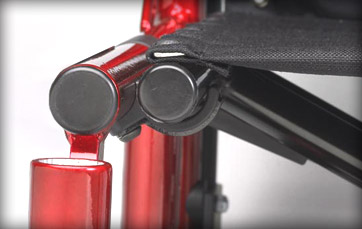
Most wheelchair seat rails sit above the frame with little lateral support. A “between-the-rails” frame design uses the side frame to provide improved support for the cross brace. Steel reinforced, composite seat hooks mount on the front and back of each side of the frame. These hooks have a subtle edge that holds and supports the seat tubes and take much of the load off of the cross braces.

Dual Interlocking Cross Braces have multiple advantages. With four (4) interlocking tubes we minimize the “racking” common in folding designs, making the chair more rigid.

Dual interlocking cross braces allow use of thinner tubing, making the chair lighter. Chairs also have less chance for failure than a single cross brace.

Power X-Hinge

The Power X-Hinge is an extensible link that expands and contracts while the frame opens. This eliminates the requirement for a parallelogram configuration.

Historically, cross braces have been engineered to form a parallelogram, which allowed the cross brace to fold. To obtain this structural configuration, the seat rail must be lined up directly over the lower pivot point, as shown in the standard cross brace design pictured at the right.

Typical construction of other “between-the-rails” wheelchairs includes welded tabs or machine blocks on the inside of the lower frame to create a place to mount and locate the bottom of the cross brace, as shown pictured on the left. This construction adds weight, cost and restricts the ability to fold up the chair.

The Power X-Hinge is better!

The Catalyst Cross Brace (pictured lower right) mounts directly into the lower frame resulting in: less weight, less cost and a narrower folding chair.

Competitive Frame Design

On some wheelchair models, the seat upholstery gets tighter and tighter until finally it snaps open as the linkage goes “over center. This indicates that:

  • The seat upholstery is an integral part of the structure of the frame.
  • The upholstery must be taut for the frame to be rigid.
  • In as little as 3 to 4 months after the customer gets their chair, the upholstery stretches.

The Catalyst is different:

  • The Catalyst's seat upholstery is independent. Remove it and the frame remains rigid.
  • The Catalyst's upholstery is not adjustable. It does not need to be.
  • Inside the cover is an ultra strong, 1300 dernier fiberglass reinforced fabric.

Fixed Front End

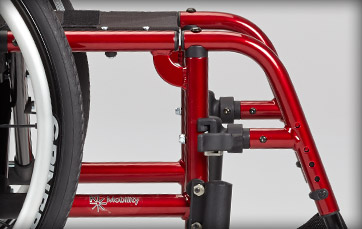
The solid front frame has added strength and durability. It is available in a 70° bend.


Heat Treated After Welding

Typical Frame Fabrication

Most U.S. chairs are manufactured using 6061-T6 aluminum. The T6 designation represents the level of heat treatment the aluminum has undergone. The higher the designation the better. The tubing is cut, bent and welded.

During the welding process the aluminum gets very hot. When it cools down the material around the weld is significantly weaker than the weld itself. This area is referred to as the “Heat Affected Zone”.

To compensate for this weakness, other manufacturers use thicker tubing is used and reinforcements are added to specific areas, usually at both the top and bottom of the front frame and the cross braces.

By heating treating the frame after welding, Ki Mobility adds significant strength to the finished product. The additional strength allows the use of thinner tubing, which saves weight. The Catalyst frame is significantly stronger than competitive models.